
Contents
Estimated reading time: 6 minutes
The Product Manager behind Immobiliare’s trust and safety architecture. On moving from 60% human review to a system where AI and humans make each other better.
Executive summary (TL;DR)
How do you build a moderation system that scales without losing accuracy? Immobiliare.it’s Lorenzo Bianco broke it down at DMA Conference 2026:
- Immobiliare.it moved from 60% human moderation to 95% automation — freeing the team to focus on higher-value work
- What used to take days now takes minutes — the speed of iteration changed everything
- 3–4% of cases are deliberately kept with human reviewers — not as a fallback, but as a strategic feedback loop
- Human reviewers went from skimming ads to generating signals that continuously improve the AI — from execution to intelligence

Most product managers talk about features shipped and metrics moved. Lorenzo Bianco talks about trust.
Lorenzo is Product Manager for the B2C team at Immobiliare.it — Italy’s #1 real estate portal. The platform has over a million active listings and is growing across Southern Europe. His role covers how sellers list, rent, and sell properties. It also covers how the platform catches fraud before it reaches buyers.
That work recently took him to the stage at DMA Conference 2026. He joined platform leaders from across Europe to share what Immobiliare.it has learned building moderation at scale.
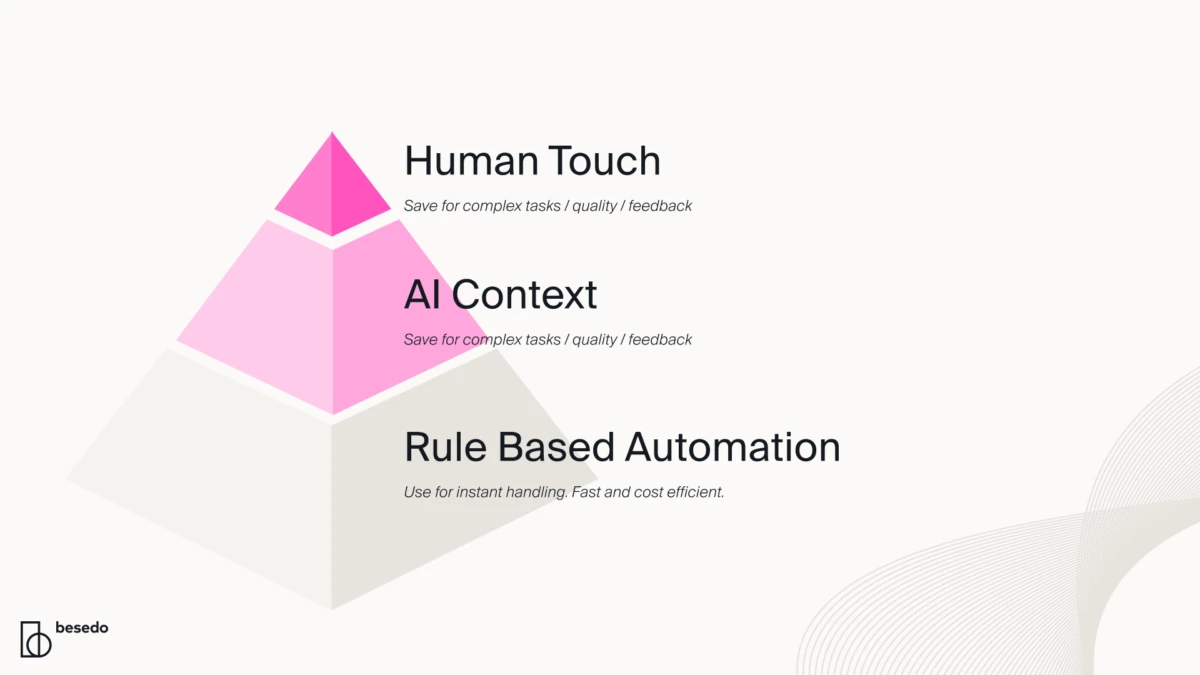
His central argument is simple. The platforms getting trust and safety right aren’t the ones chasing full automation. They’re the ones who figured out that automation, AI, and human judgment work best as a stack, not as alternatives.
About Immobiliare.it
Founded over 20 years ago, Immobiliare.it is Italy’s #1 real estate portal and one of Southern Europe’s most technically ambitious consumer platforms. With over a million active listings, a team of over 200 in-house developers, and operations in Spain, Greece, Luxembourg, Slovenia and Croatia, the platform connects millions of buyers, sellers, and renters every month.
The platform faces two distinct moderation challenges at scale:
Listing moderation: thousands listings to assess every day — where fraud is sophisticated, paid, and designed to look legitimate. The risk isn’t in bad content. It’s in subtle behavioural patterns invisible to rule-based systems.
Message moderation: Real-time decisions on every conversation between buyers and sellers – the platform’s core value unit and the primary vector for scammers trying to move users off-platform.
The platform is free for users. Revenue comes from selling visibility to agencies and private advertisers, helping them generate qualified contacts, which means trust isn’t just a safety concern. It’s the foundation of the entire marketplace.
Step One: Automate the Simple Stuff (Ruthlessly)
The starting point for any moderation system is removing obvious decisions from the human queue. For Immobiliare.it, that meant moving away from hard-coded rules. Before the change, updating filters required coordination across product and engineering, development time, release cycles, and post-release analysis. As Lorenzo puts it:
“We felt slow, not only in making iterations, but also in analysing results. What we do now in minutes took days before.”
At the same time, more than half of all cases were going to human review. The team spent most of its time manually checking listings that followed predictable patterns. It worked but it made scaling improvements slow.
The priority became shifting that balance. Today, more than 95% of cases are handled automatically, mainly the clear, repeatable scenarios that don’t require human judgment. Automating the foundational layer created the space to focus people and systems on more nuanced decisions higher up the stack.
Step Two: Use AI to Build Context, Not Just Enforce Moderation Rules
Automation handles the obvious. AI handles the ambiguous. That distinction is where most moderation systems win or fail. Lorenzo explains it with a simple question: how do you spot a fraudulent property listing in Rome?
“Counterintuitively, a very good-looking listing can be a scam. Scammers don’t necessarily publish low-quality ads. Often they use paid visibility, good photos, and polished descriptions. On the surface, everything looks legitimate.”
The real signal is rarely the listing itself. It comes from the surrounding context, behavioural patterns, account history, naming combinations, or the sequence of actions before a listing went live. Individually, these signals look harmless. Together, they reveal risk patterns that static rules can’t catch.
The same applies to message moderation. Traditional systems ask: does this message contain a link, a phone number, or suspicious wording? But in a marketplace, those things are often completely normal.
“The most important thing is not only the content of the message, it’s the context of the conversation.
You can be very strict and say every message with a link is suspicious. But it’s very common among people to share links or phone numbers. You can’t just use a high-level rule. You have to have the whole picture.”
This is where AI changes the approach: not by replacing human judgment, but by connecting fragmented signals into a more contextual understanding of risk.
Step Three: Make the Human Touch Your Luxury Differentiator
The dominant narrative in trust and safety right now is about pushing automation rates as high as possible. Many teams are racing toward 100% automated review. Lorenzo believes that’s the wrong goal.
“We shouldn’t aim for 100% automation. We still need humans in the loop for the most critical, ambiguous and high-value cases.”
For Immobiliare.it, the remaining 3–4% of manually reviewed cases are not considered system failures. They are intentional escalation points: complex or ambiguous situations where human judgment adds real value.
What changed is not the existence of human review, but the role humans play inside the process.
Previously, reviewers had to reconstruct every case manually, gathering account information, checking behavioural patterns, and piecing together the context needed to make a decision. Today, much of that preparatory work is handled upstream by AI systems, allowing reviewers to start from a more informed position.
“Two years ago, even when a case reached a human team, they still had to do all the research themselves,” Lorenzo says. “Now AI helps frame the case and orchestrates the critical ones with context, so humans can focus on the actual decision-making.”
This also changed what the moderation team does day to day. What was repetitive validation became analytical work like reading signals, spotting emerging patterns, and feeding structured feedback back into the system.
“Before, a lot of the work was manually checking listings and trying to understand whether they were legitimate. Now the focus is much more on reading signals and helping improve the moderation system itself. I don’t see it like AI is replacing humans, AI is empowering humans within our company.”
Human involvement also remains essential for another reason: continuous improvement. There’s a second reason humans stay in the loop that Lorenzo considers equally important: the feedback loop itself.
If you don’t have humans in the loop, it’s very hard to catch optimisations. The critical eye of a person can spot where the system is making mistakes, or where it can be improved.
Lorenzo Bianco, Product Manager, Immobiliare.it
Without that feedback loop, the system stops learning.
Key Takeaways for Product and Trust & Safety Leaders
- Start by flipping the ratio. If more than half your moderation cases are going to human review, the foundation isn’t right yet. Immobiliare.it moved from 60% human review to 95% automation — and that shift is what made everything else possible.
- Context beats content every time. Moderation built on isolated signals will always be outpaced by sophisticated fraud. The winning architecture synthesises account history, behavioural patterns, and conversation context together before any decision is made.
- AI’s highest value is preparing the ground for human judgment. The goal isn’t AI instead of humans, it’s AI that assembles the full picture instantly, so that the 3–4% of cases that need a human can be resolved fast, confidently, and at scale.
- Human reviewers are a learning system, not a fallback. Moving from four people skimming listings to two people generating feedback signals isn’t a headcount reduction — it’s a capability upgrade. That feedback loop is what
keeps the whole system improving.
This article is based on Lorenzo Bianco’s session at DMA Conference 2026 (Digital Marketplace Association), where he joined platform leaders from across Europe to discuss the future of AI in trust and safety in online marketplaces.
About Lorenzo Bianco
Lorenzo Bianco is a Product Manager on the B2C team at Immobiliare.it, Italy’s leading real estate portal. With over a million active listings, a team of more than 200 developers, and operations across Southern Europe, Immobiliare.it is one of the region’s most active AI-native consumer platforms. Lorenzo spoke about the future of platform trust and safety at DMA Conference 2026 (Digital Marketplace Association).
Questions We Hear a Lot
Q: What is a good automation rate for content moderation?
A: Automation rate alone is the wrong metric. What matters is whether your three-layer stack is working together: automation handling the clear, repeatable cases; AI building contextual understanding of ambiguous ones; and human reviewers focusing on the most complex decisions. When those three work in combination, high automation rates follow naturally — and quality improves at every layer, not just throughput.
Q: How do you detect sophisticated fraud that looks legitimate on the surface?
A: By reading context, not just content. Fraudulent listings often use professional photos, paid visibility, and polished copy — so surface-level checks miss them. Effective fraud detection synthesises behavioural patterns, account history, and the sequence of actions before a listing or message was posted.
Q: Should you aim for 100% automated moderation?
A: No. Some cases should be kept with human reviewers intentionally. Not as a fallback, but as a feedback loop. Human reviewers spot where the AI is making mistakes and generate the signals that keep the system improving. Without that loop, accuracy degrades over time.
Q: How do automation and AI improve the speed of trust and safety operations?
A: Both remove different bottlenecks. Automation eliminates the need for human review on routine, repeatable cases — decisions that previously clogged the queue. AI removes the dependency on engineering cycles for everything else: where rule-based systems require development time and release windows to update, AI-powered moderation can adapt to new fraud patterns and iterate in minutes rather than days.
Q: What happens to human moderators when AI handles routine review?
A: Their role upgrades. Instead of manually reconstructing cases and skimming listings, reviewers shift to analytical work — interpreting signals, identifying emerging patterns, and feeding structured feedback back into the system. Fewer people doing higher-value work.
Q: What is the difference between content-based and context-based moderation?
A: Content-based moderation evaluates what’s in a message or listing — keywords, links, images. Context-based moderation looks at the full picture: account history, behavioural patterns, and conversation flow. Context-based systems catch fraud that content-only approaches miss, including sophisticated actors who deliberately mimic legitimate behaviour.
Ahem… tap, tap… is this thing on? 🎙️
We’re Besedo and we provide content moderation tools and services to companies all over the world. Often behind the scenes.
Want to learn more? Check out our homepage and use cases.
And above all, don’t hesitate to contact us if you have questions or want a demo.
Share this article


