
Contents
Estimated reading time: 10 minutes
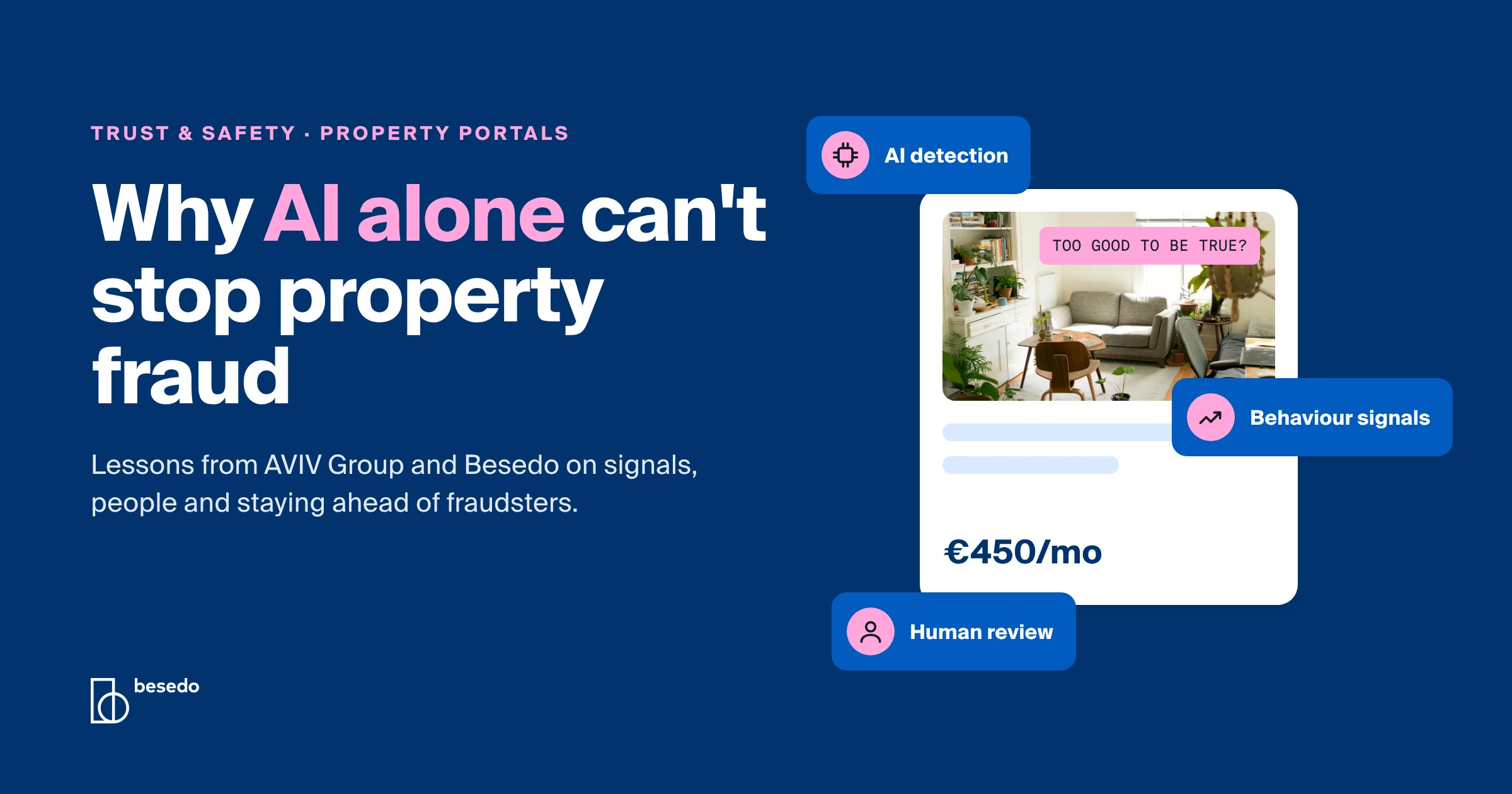
AI makes fraud detection faster, but it doesn’t make a property portal trustworthy on its own. AVIV Group’s Inessa Karapetyan, whose team has cut fraudulent listings by 90%, explains why. Besedo’s Edouard Clep shows what it takes around it: behavioural signals read over time, and human review for what automation can’t settle.
Key Takeaways
- AI makes detection faster, but it can’t establish trust on its own. Trust comes from behavioural signals, people and constant adaptation.
- Build vs. buy is the wrong question for fraud prevention. AVIV sets its priorities in-house and partners for what’s hard to build alone: cross-market fraud expertise, speed and 24/7 coverage
- Trust is a growth metric: seekers return when they trust the listings, and owners stay when enquiries are real.
- Catching fraud is only half the job. Precision matters just as much, so genuine owners aren’t blocked by mistake.
- Stopping a fake listing takes several layers of detection: listing signals, account behaviour over time, data, human review and chat moderation.
- Fraudsters strike fast and outside office hours, so reaction speed and round-the-clock coverage are essential.
- If you learn about a new scam pattern from user complaints, you’re already too late.
Most people have come across a listing that felt wrong: a flat priced far below the market, photos that look borrowed, an owner who wants a deposit before a viewing. Each one costs a property portal more than a single bad experience. It makes seekers doubt every other listing on the site, and it makes owners and agents question whether the enquiries they get are worth answering.
So what does it take to build a portal people trust enough to come back to? We put that question to Inessa Karapetyan, Engineering Manager leading anti-fraud at AVIV Group, the company behind SeLoger, immowelt and Immoweb, and to Edouard Clep, Senior Customer Success Manager at Besedo, who has spent 16 years in trust and safety. The conversation, hosted by Besedo CCO Marc Durhoff, took place on stage of PPW Madrid.
The short answer: AI is essential, but it isn’t enough. Trust comes from a system that combines technology, people and expertise, and keeps adapting, because the people testing it never stop.
Trust is a growth metric, not a safety metric
Most portals file fraud prevention under risk or compliance. Inessa sees it differently: it’s what makes the business work in the first place.
Portals changed how people find a home. Seekers now get a huge range of options in one place, and that only works if the place is safe. The job of a trust and safety team, as she puts it, is to create a space where seekers and owners can talk to each other with confidence.
When that works, seekers trust the listings they see and trust that they’re talking to genuine people. That trust is what brings them back, and it’s what keeps owners and agents posting.
Catching fraud is only half the job
The other half is not getting in the way of everyone else. A system that cuts fraud sharply but also blocks a large share of genuine owners would damage the business it’s meant to protect. That’s why precision matters as much as detection: catching enough fraud while keeping false positives low.
“Nobody wants to hear ‘we reduced fraud by 90%, but we also block 90% of legitimate customers.’ That’s where you harm your business.” Inessa Karapetyan, AVIV Group
Build vs. buy might be the wrong question
Should a portal build its fraud defences in-house or bring in a partner? Inessa’s answer is that it isn’t a binary choice. AVIV took a hybrid approach.
When the team was first set up, the priority was to understand where the biggest fraud problems were and decide which bets to make. What AVIV didn’t have was the view a vendor gets from working across many platforms and industries: which signals matter, and which patterns are spreading. Partnering gave them that expertise and let them move faster.
Speed matters because of how fraudsters operate. They know they’ll be caught eventually, so they try to do as much damage as possible in as little time as possible. The portal’s job is to react fast enough to keep that damage small. And they don’t keep office hours.

“Fraudsters don’t take Sunday off. They may be even more active on Sunday, because they know people don’t work.” Inessa Karapetyan, AVIV Group
That’s why AVIV needed more than a tool. It needed operational infrastructure: moderation that keeps watch close to 24/7, including weekends and outside working hours. Whether a portal builds that itself or partners for it, someone has to be watching when fraudsters are.
Stopping a fake listing takes several layers of detection
From the outside, stopping a fake listing looks like a single check. Edouard described it as a series of layers, each catching what the one before it misses.
- The listing itself. Start with the obvious markers in what the user submits. A price that doesn’t fit the property’s size is one of the simplest. Context matters too: in tight rental markets, where demand outstrips supply, these signals deserve closer attention.
- How it was posted. Beyond the listing, look at the behaviour of the account behind it. Has the user changed IP address? Are they suddenly posting in a new region or category? Viewed over months, these patterns help answer the harder questions: was this account fraudulent from day one, or has a genuine account been taken over?
- The data you didn’t think mattered. Some of the most useful signals come from data teams rarely think to share, such as details about the device being used. Edouard’s advice is to give your fraud team as much of it as possible.
- People for what automation can’t decide. AI handles most of the volume, but trained moderators review what’s left: the ambiguous cases and the new patterns. At Besedo, automation covers the large majority of items, with a human team for the small part that needs judgement.
- The conversation. Some fraud only shows up after publication, in the messages between users. Chat moderation spots attempts to move people off the platform as they happen.
And all of this has to keep changing. As Edouard put it during the Q&A, ask him tomorrow which scam is most common and you may get a different answer.
AI vs. human moderation: AI can’t establish trust on its own
AI has changed how portals fight fraud, and both speakers are clear that it’s essential. But the sharpest point of the session was about its limits.
AI makes detection faster. It helps AVIV react much faster and makes it easier to spot patterns in fraud. At Besedo, AI drives most of the automation, and a manual team reviews the cases AI can’t figure out, so nothing is missed.
But AI can’t establish trust on its own. It can help seekers search and get recommendations, but it can’t tell them whether the person behind a listing is genuine. That takes behavioural signals read over time, and people who handle the 2 to 5% of cases automation can’t settle: the ambiguous ones, and the new patterns models haven’t seen yet.
And fraudsters use AI too. Fake listings were already automated, so the bigger shift is in conversations: an AI agent can now message seekers at a scale that once needed a person. Fraudsters sometimes understand a platform’s systems better than the people who built them. Close one gap, and fraud leaks from another.
That’s why the answer isn’t AI or humans, and it isn’t build or buy. It’s a system that combines them and keeps adapting, with people learning from every new pattern and feeding it back into the models.
If users report it first, you’re already too late
We asked both speakers to imagine they were the CEO of a property portal. What’s the one thing they’d prioritise tomorrow to build more trust?

Inessa: invest in systems and people that read behaviour. Trust depends on knowing what’s behind a listing, and that means analysing signals such as IP changes, login locations and signs of account takeover. Above all, she’d invest in people: moderators who review listings and user behaviour, so what goes live is something users can rely on.
Edouard: get ahead of fraud, not behind it. Have someone whose job is to stay a step ahead of fraudsters, even if it’s one person. It’s a full-time job just to keep up.
“If you start learning about a fraud pattern when your users start complaining, you’re already too late.” Edouard Clep, Besedo
His second priority: don’t underestimate data. Share as much as you can with whoever runs fraud detection, including details that seem irrelevant.
A quick self-check for portal leaders
- How would you find out about a new scam pattern today: from your own detection, or from user complaints?
- How many genuine owners and agents does your fraud detection block by mistake?
- Who is watching your platform at 3 a.m. on a Sunday?
- What data could help your fraud team that it doesn’t get today?
Fighting fraud is never finished
Marc closed the conversation with a summary worth keeping: fraud prevention isn’t a project you finish. It’s infrastructure you run. Decide what you own and partner on the rest. Keeping up with fraud is a full-time job, and every hour your best people spend on it is an hour they’re not building your product.
The portals people come back to are the ones that treat fraud prevention this way. Seekers trust what they see. Owners and agents get enquiries worth answering. And most users never notice the work, because the fake listings are gone before anyone finds them.
That’s the approach behind Besedo’s Trust & Safety Infrastructure: AI, human reviewers and fraud expertise working as one system, instead of separate tools stitched together.

FAQ
What are the most common scams on property portals?
Account takeovers are one of the biggest problems across marketplaces, because a hijacked account already looks trusted. Fake listings with prices too good to be true, and attempts to move conversations and payments off the platform, are also common. The patterns change constantly, and AI now lets fraudsters run scam conversations with seekers at a much larger scale.
Should we build or buy a content moderation platform?
It doesn’t have to be one or the other. AVIV took a hybrid approach: its own team sets priorities and decides where to invest, and it partners with Besedo for cross-market fraud expertise, fast-moving tooling and near 24/7 human moderation. A partner is most valuable for what’s slow or expensive to build alone.
How does AI content moderation compare with human moderation?
AI handles volume and speed, and it makes patterns in fraud easier to spot. At Besedo, AI drives most of the automation. A manual team reviews the remaining 2 to 5%, the cases AI can’t figure out, so nothing is missed. The two work best as one system, with people learning from every new pattern.
Can content moderation software detect fake accounts?
Yes, by looking at behaviour, not just content. Signals such as changes in IP address, login country, region or category, tracked over months, help show whether an account was fraudulent from day one or is a genuine account that has been taken over. Data that seems irrelevant, such as device details, can also reveal fraud patterns.
How do we evaluate content moderation accuracy?
Measure both sides: how much fraud you catch, and how many legitimate users you block by mistake. A system that cuts fraud sharply but also blocks genuine owners damages the business it’s meant to protect. AVIV treats precision, keeping false positives low, as just as important as detection.
Share this article


